 Leadcase
Conflict Escalation Model
Understanding the dynamics of conflict for effective resolution
🤔 Recognizing the conflict
Have you ever found yourself in a situation where a minor disagreement spiraled out of control, escalating into a full-blown conflict? This can happen in personal relationships, workplaces, and community settings, often leading to frustration and negative outcomes.
Understanding conflict dynamics can empower you to address issues before they escalate. This is where Glasl's Nine-Stage Model of Conflict Escalation comes in. It provides valuable insights into how conflicts develop and offers guidance on intervention strategies.
🚦 Stages of conflict escalation
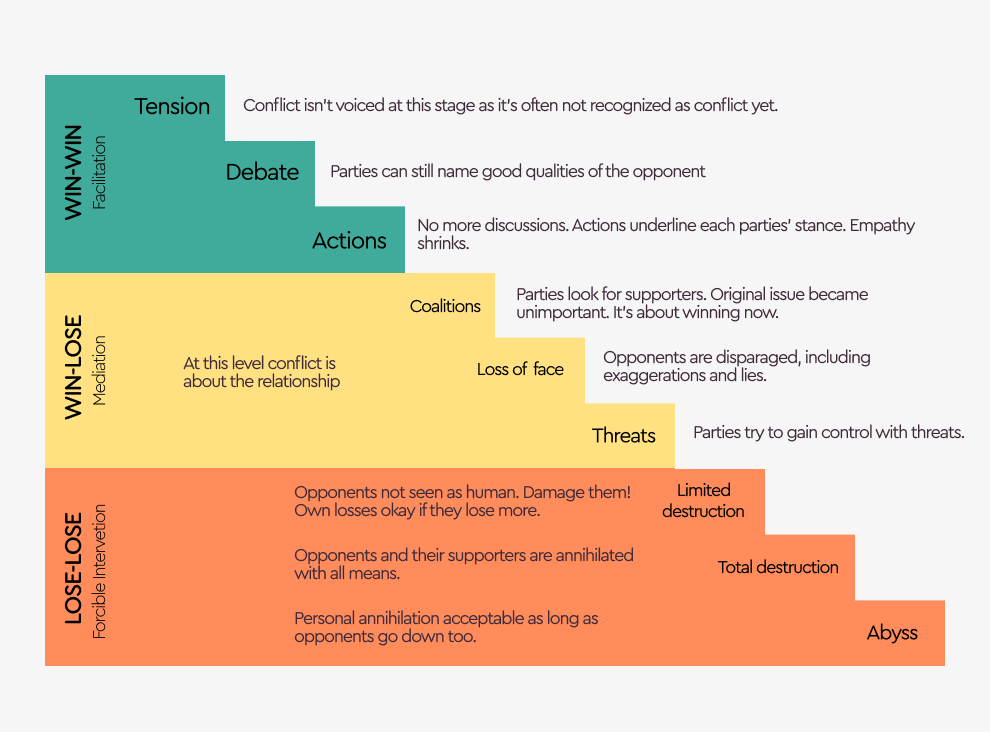
Glasl’s model outlines nine stages of conflict escalation, which can be grouped into three key phases:
- Early Stages ("Win-Win")
- Higher Tension Stages ("Win-Lose")
- Final Stages ("Lose-lose")
🕵️♂️ Early stages ("Win-Win")
In these initial stages, conflicts often remain manageable. However, it's crucial to identify the warning signs early.
Stage 1: Hardening
The conflict is minor, and parties hold strong positions but haven’t yet engaged in negative interactions.
Example: Two coworkers disagree on a project approach but can discuss it calmly.
Stage 2: Debate
A disagreement evolves into a debate where parties argue their positions more aggressively.
Example: The coworkers begin debating their methods during team meetings, but still maintain a level of respect.
Stage 3: Action
The situation intensifies as individuals may take action to assert their viewpoint, leading to unhealthy competition.
Example: One coworker starts to undermine the other’s contributions, seeking to rally support from others.
📈 Higher tension stages ("Win-Lose")
The conflict becomes more pronounced, and parties may struggle to communicate effectively.
Stage 4: Image and coalitions
At this stage, parties start to form coalitions and may manipulate situations to gain support.
Example: The coworkers gather allies who share their perspectives, leading to a division in the team.
Stage 5: Loss of face
Individuals may feel threatened, leading to aggressive responses, and personal attacks may occur.
Example: Hostile comments are made about the other person's competence within the group.
Stage 6: Threat as a strategy
Threats or ultimatums are used to exert power and pressure, reflecting a breakdown in communication.
Example: One coworker threatens to escalate the issue to management if their views aren’t prioritized.
🔥 Final stages ("Lose-lose")
The conflict reaches levels that may cause lasting damage if not resolved effectively. At this point, intervention is crucial.
Stage 7: Limited destruction
The conflict escalates to destructive behaviors, with focused attacks on the opponent’s position and credibility.
Example: False accusations and sabotage occur in the workplace.
Stage 8: Total destruction
The conflict becomes fully destructive, where parties entirely abandon discussions and engage in mutual aggression, often involving outsiders.
Example: The team breaks into factions, leading to a toxic workplace environment where collaboration ceases.
Stage 9: Together into the abyss
The final stage signifies irreversible damage and complete breakdown; resolution power becomes ineffective.
Example: Relationships are severed, leading to resignations and severe impacts on team morale and productivity.
Model of de-escalation
Conflicts at levels 1–3 can often still be resolved peacefully between the parties involved. Sometimes, a neutral third party, like a parent encouraging children to reconcile, can help mediate the situation.
Once a conflict reaches level 4, external assistance is usually required.
Friedrich Glasl proposed the following de-escalation model for conflict resolution:
- Stages 1–3: Self-resolution is still possible.
- Stages 2–3: Support from friends, family, or informal moderators can be effective.
- Stages 3–5: Professional guidance from external facilitators is helpful.
- Stages 4–6: Socio-therapeutic support may be needed.
- Stages 5–7: Professional mediation is required.
- Stages 6–8: Voluntary or even mandatory arbitration may be necessary.
- Stages 7–9: Only authoritative intervention (e.g., from leadership or legal institutions) can resolve the conflict.
By identifying these stages without bias, it's possible to intervene at the right moment and resolve conflicts more quickly and effectively

