 Leadcase
Leadership Uncertainty Matrix
Match your mindset to the situation. Optimism or discipline, depending on clarity.
🧭 Two things leaders often confuse
When facing a difficult situation, leaders tend to treat their emotional response as if it were an accurate reading of reality. They feel uncertain, so they assume the situation is unclear. Or they feel confident, so they assume the situation is under control.
The Leadership Uncertainty Matrix separates these two things:
- Reality: is the situation determinate (clear) or indeterminate (uncertain)?
- Attitude: are you responding with optimism or pessimism?
Getting this combination right is one of the most underrated leadership skills.
🗂 The Matrix
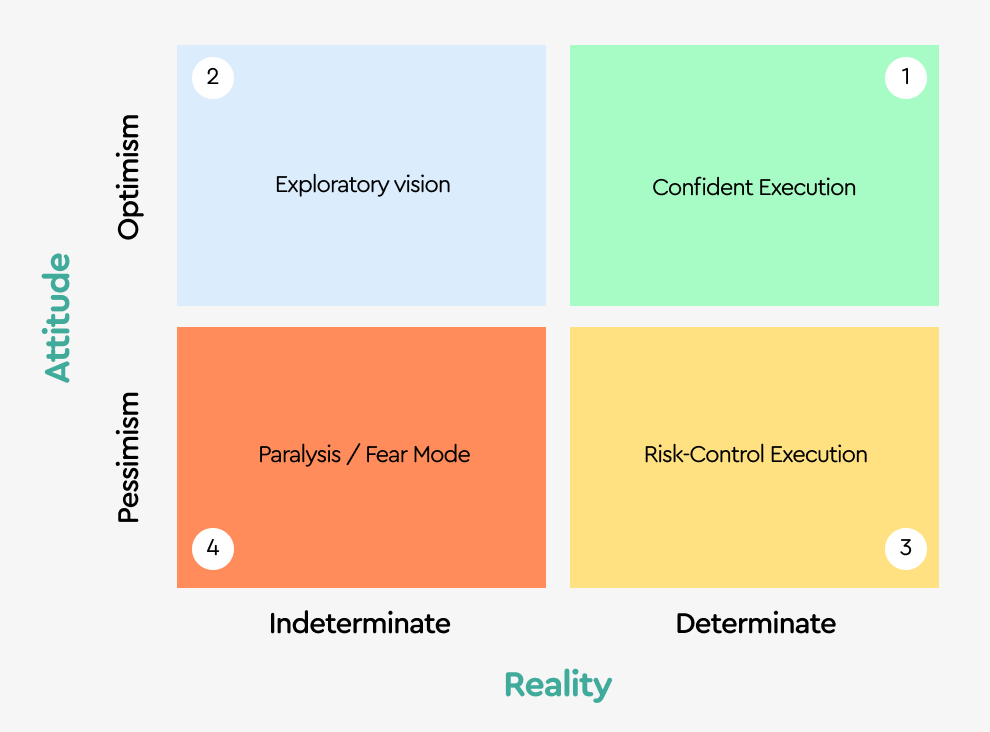
The matrix creates four quadrants based on two axes:
- Horizontal axis: Determinate (clarity exists) vs. Indeterminate (uncertainty)
- Vertical axis: Optimism vs. Pessimism
Each quadrant describes a distinct leadership mode. Two of them are effective, two of them are costly.
🟩 1. Confident Execution
Situation: Determinate + Optimism
Mindset: "We know what to do. Let's win."
This is the optimal mode for clear, structured situations. The path forward exists, and the leader's job is to drive the team toward it with energy and direction.
Behaviors:
- Strong, clear direction
- Well-defined goals and KPIs
- Fast, decisive execution
- High team confidence
Best for: Scaling operations, proven systems, repeatable processes.
Watch out for: Overconfidence, ignoring edge cases or signals that the situation has changed.
🟦 2. Exploratory Vision
Situation: Indeterminate + Optimism
Mindset: "We don't know yet, but we'll figure it out."
This is the optimal mode for ambiguous, novel situations. Instead of forcing premature clarity, the leader frames uncertainty as opportunity and fuels the team's curiosity.
Behaviors:
- Encourages experiments over fixed plans
- Frames uncertainty as a source of learning
- Builds energy and momentum in the team
- Focus on feedback loops and discovery
Best for: Innovation, new products, strategy pivots, early-stage exploration.
Watch out for: Unrealistic optimism, ignoring real constraints or avoiding necessary decisions.
🟨 3. Risk-Control Execution
Situation: Determinate + Pessimism
Mindset: "We know what to do, but let's be careful."
The path is clear, but the leader is focused on what could go wrong. This can be appropriate in high-stakes environments, but easily tips into over-caution.
Behaviors:
- Heavy focus on risks and edge cases
- Strong controls and review processes
- Slower, more careful execution
- Multiple approval layers
Useful when: Failure is expensive: finance, healthcare, compliance, safety-critical systems.
Watch out for: Bureaucracy, decision bottlenecks, and teams that stop taking initiative.
🟥 4. Paralysis / Fear Mode
Situation: Indeterminate + Pessimism
Mindset: "We don't know… and this is dangerous."
This is the mode to avoid. Uncertainty is real, but the pessimistic response to it produces no movement: only analysis, delay, and anxiety.
Behaviors:
- Avoidance of decisions
- Endless analysis waiting for certainty that won't come
- Low energy, low trust in the team
- Missed windows of opportunity
Result: No progress, declining team morale, and falling further behind.
⚡ Matching mindset to reality
Great leaders don't just pick an attitude. They match their mindset to the actual situation they're in.
| Situation | Best mindset |
|---|---|
| Determinate | Slight optimism + discipline |
| Indeterminate | Strong optimism + curiosity |
The key insight: uncertainty requires optimism. Without it, you get paralysis. Clarity requires discipline. Without it, you get sloppy execution.
🚨 Common failure patterns
Indeterminate + Pessimism: teams get stuck, leaders wait for a plan that never arrives.
Determinate + Too much optimism: execution is fast but careless, and important risks get ignored.
Determinate + Too much pessimism: the answer is known but the team moves too slowly to matter.
🚀 Applying the matrix
- Name the reality. Ask honestly: is the path forward clear, or genuinely unknown? Resist the urge to treat your current feelings as the answer.
- Check your default mode. Under pressure, which quadrant do you tend toward? Is it serving the situation?
- Adjust your communication. In indeterminate situations, talk about learning and experiments. In determinate ones, talk about direction and execution.
- Watch for drift. Situations shift over time. A product launch that starts in Exploratory Vision should migrate toward Confident Execution once a direction becomes clear.

